
The Importance of Our Senior Brothers
Throughout my journey in Jook Lum Southern Praying Mantis, I have been fortunate to study with teachers who have profoundly influenced my understanding of martial arts.
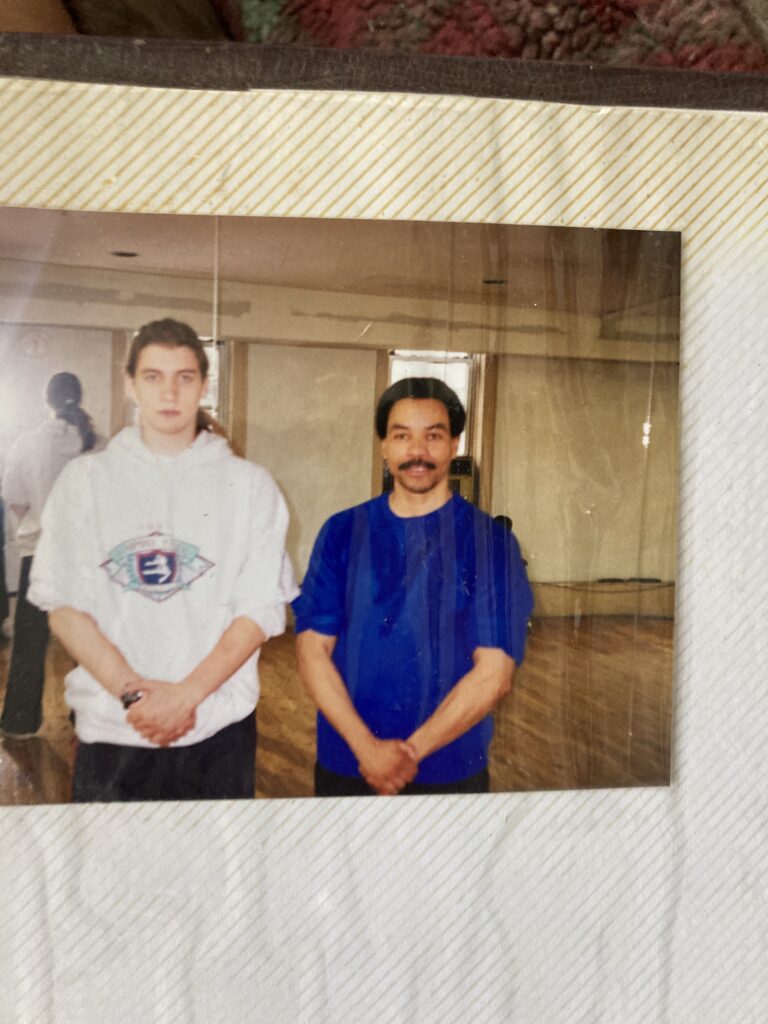
My earliest training in the system was under Sifu Ralph Mitchell, followed by my studies with Sifu Louie Jackman. Along the way, two senior practitioners played particularly important roles in my development: Nardu Debrah, Sifu Ralph Mitchell’s top student, and Maurice Tunstall, Sifu Louie Jackman’s top student.
In traditional Kung Fu, we often speak of our Dai Sihing, our senior martial arts brothers. These individuals can become just as influential in our development as our teachers themselves.
A teacher provides the foundation, principles, and direction of the art. But often it is our senior brothers who help us bring those principles to life. They are the ones we spend countless hours training with, testing techniques against, exchanging ideas with, and discovering the difference between knowing something intellectually and being able to express it physically.
In many ways, they become the bridge between what our teachers show us and what we eventually make our own.
Sensitivity: The Heart of Southern Praying Mantis
One of the defining characteristics of Jook Lum Southern Praying Mantis is the development of sensitivity through touch.
This sensitivity is not something that can be developed in isolation. It requires another person—someone who understands the principles of the system and is willing to participate in the long process of refining them.
Through two-person drills, sticking-hands exercises, and eventually more spontaneous, live Chi Sao, the practitioner begins to develop an awareness that goes beyond simply seeing an attack and reacting to it.
You begin to feel intention, pressure, changes in structure, and the subtle movements that reveal where your training partner is strong and where they are vulnerable.
Over time, this sensitivity becomes increasingly refined.
But sensitivity alone is not enough.
Sensitivity Tempered With Aggression
Different branches and practitioners of Southern Praying Mantis may express the art differently. Methods, training approaches, and interpretations can vary considerably.
Yet I believe most would agree that sensitivity is an essential part of the system.
To me, one of the great hallmarks of Jook Lum is sensitivity tempered with aggression.
But to be truly aggressive, one must first learn to be intelligently defensive.
This was something Sifu Ralph Mitchell stressed repeatedly throughout my training.
The ability to neutralize an opponent’s offense, disrupt their structure, and shut down their ability to attack creates the opportunity for a decisive offensive response.
When this is done through highly developed sensitivity, it can almost seem like a superpower.
The practitioner is not simply reacting to what is happening. Through touch, structure, timing, and positioning, they begin to recognize what is developing before it fully manifests.
The defensive and offensive aspects of the art become inseparable.
Pressure Testing the Art
One of the beautiful things about Southern Praying Mantis is that its training methods allow us to explore these principles under increasing levels of pressure.
A cooperative two-person drill teaches us the mechanics and the feeling of a technique.
But as the practitioner develops, the training must evolve.
The partner begins to resist, change angles, interrupt movements, and introduce unexpected pressure.
This is where live Chi Sao becomes so valuable.
It gives us the opportunity to pressure-test our understanding when things are not going according to plan.
Anyone can demonstrate a technique when the other person responds exactly as expected. The real question is whether the underlying principles remain effective when the situation becomes unpredictable.
This is where sensitivity, structure, timing, and intelligent aggression must come together.
It is also where a good training partner becomes invaluable.
The Connection Between Practitioners
There is another aspect of this training that I find particularly beautiful, and that is the connection it creates between people.
With the right training partner, exchanging techniques can become an incredibly enjoyable experience.
You begin to bounce back and forth, feeling each other’s movements, neutralizing attacks, creating openings, and responding almost instinctively.
Sometimes the exchange becomes so fluid that it feels less like a fight and more like a conversation.
Through touch, you can feel the years of training in another practitioner.
You can recognize the countless hours they have spent refining their structure, sensitivity, timing, and understanding of the art.
There is something remarkable about being able to experience another person’s martial arts development in such a direct and physical way.
No lengthy explanation is necessary. Their training speaks through their hands.
And when two people have spent years cultivating these skills, the exchange can become something quite extraordinary.
An Art That Cannot Be Learned Alone
Looking back on my years in Jook Lum Southern Praying Mantis, I am deeply grateful not only for the teachers who introduced me to the system, but also for the senior brothers and training partners who helped me understand it.
Sifu Ralph Mitchell and Sifu Louie Jackman provided the foundation and direction for my studies. Nardu Debrah and Maurice Tunstall helped bring so many of those lessons to life through their willingness to share, train, and explore the art.
The development of sensitivity is a lifelong pursuit. It cannot be rushed, and it certainly cannot be accomplished alone.
It requires patience, pressure, repetition, trust, and the willingness to continually challenge our understanding.
Perhaps that is one of the most beautiful lessons of Southern Praying Mantis.
Although martial arts is often described as a journey of self-development, some of its most profound lessons can only be discovered through another person.